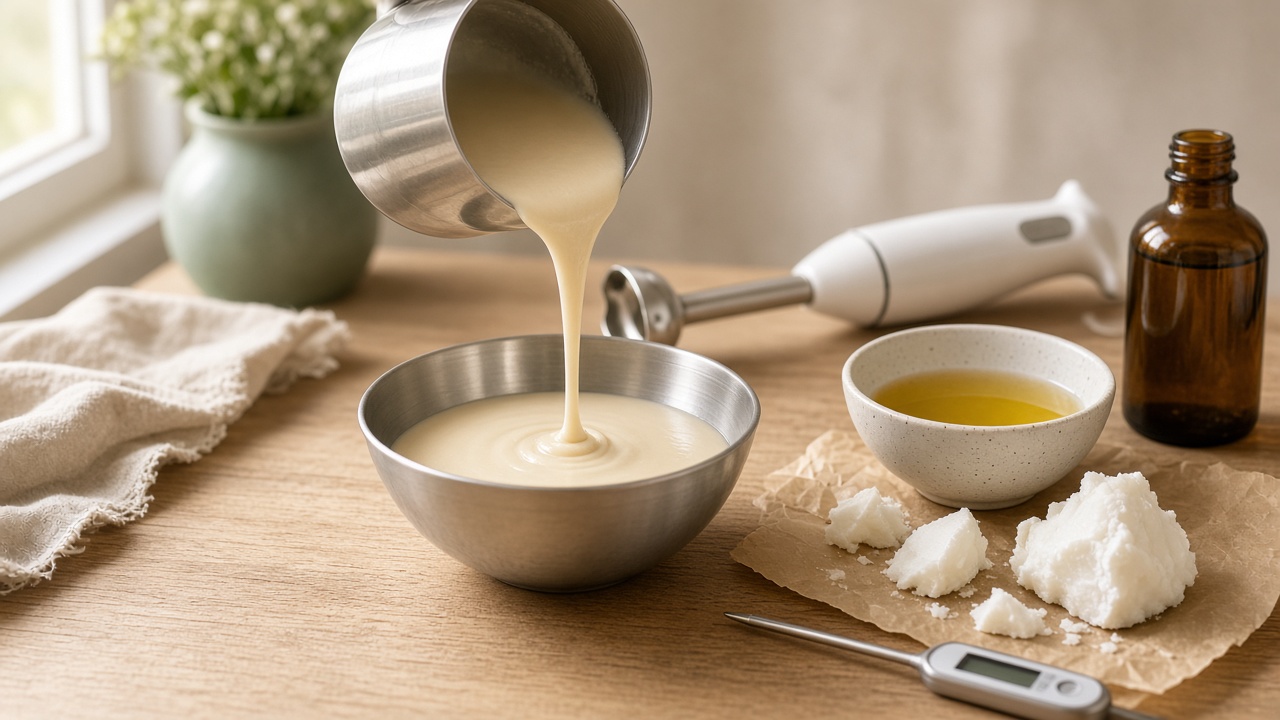
Why Is My Soap Not Tracing? Understanding False Trace in Soap Making
You have measured your oils, prepared your lye solution, combined everything, and started blending.
A few minutes pass.
Then a few more.
Your soap batter still looks almost as thin as when you started.
Or perhaps the opposite happens: the mixture suddenly becomes thick almost immediately, giving the appearance that your soap has reached trace even though something does not seem right.
Both situations lead to a common soap-making question:
Why is my soap not tracing?
In cold process soap making, trace is an important stage of the saponification process, but trace does not always happen at the same speed. Some recipes can reach trace very quickly, while others may remain fluid for quite a while.
And sometimes what appears to be trace is not trace at all.
That is known as false trace.
Understanding the difference between slow trace, true trace, false trace, and an emulsion that has not formed correctly can help you diagnose a recipe before a batch becomes a bigger problem.
What Is Trace in Soap Making?
Trace is the stage during soap making when the oils and lye solution have formed a sufficiently stable emulsion and the saponification reaction is underway.
Soap makers often describe trace by watching what happens when a small amount of batter is drizzled across the surface.
At a light trace, the drizzle may leave a faint line or mark before disappearing back into the batter.
As the mixture continues to thicken, you may see:
- Light trace
- Medium trace
- Thick trace
The appearance is somewhat similar to the changing consistency of cake batter or pudding.
However, thickness alone does not prove that a soap has reached true trace.
That distinction becomes especially important when diagnosing false trace.
What Is False Trace in Soap Making?
False trace occurs when fats or oils begin to cool and solidify, making the soap batter appear thicker even though the oils and lye solution have not formed a stable emulsion.
The batter can look as though it has reached trace.
But chemically, it may not actually be there yet.
This most commonly happens when a recipe contains a significant amount of oils or butters that are solid at room temperature, such as:
- Coconut oil
- Palm oil
- Tallow
- Lard
- Shea butter
- Cocoa butter
- Mango butter
- Other high-stearic or high-palmitic fats
If those ingredients begin cooling below their melting range after the lye solution is added, they can start becoming solid again.
The resulting mixture becomes thicker.
That thickness can easily be mistaken for trace.
What Does False Trace Look Like?
False trace often appears very early after combining the oils and lye solution.
You may notice:
- Unexpectedly fast thickening
- A grainy or waxy appearance
- Small solid-looking pieces in the batter
- Batter that resembles pudding almost immediately
- Thick batter even though very little mixing has occurred
- Oily areas appearing after the mixture sits
- Separation after pouring into the mold
A true emulsion should remain reasonably uniform.
False trace can sometimes begin separating because the lye solution and oils were never properly emulsified.
One useful clue is temperature.
If you are working with hard fats and both the oils and lye solution are relatively cool, apparent trace occurring almost immediately should make you suspicious of false trace.
Why Does False Trace Happen?
The most common cause is simple:
Your solid fats became too cool.
Consider a recipe containing coconut oil, tallow, cocoa butter, and olive oil.
The recipe may initially be completely liquid because the hard fats were melted.
When a cooler lye solution is added, however, the temperature of the oil mixture can drop rapidly.
If the temperature falls enough, some of those hard fats may begin solidifying.
The batter thickens.
It looks like trace.
But instead of saponification causing the thickening, physical solidification of the fats is causing it.
That is false trace.
Soap-Making Temperature and False Trace
Temperature is therefore particularly important when working with recipes containing large amounts of hard oils and butters.
There is no single perfect soap-making temperature for every recipe.
A formulation containing mostly liquid oils behaves differently from one containing large amounts of tallow, palm oil, coconut oil, or hard butters.
The important principle is that your fats should remain fully melted while you are establishing the emulsion.
If your recipe contains ingredients with relatively high melting points, soaping too cool increases the possibility of false trace.
This does not mean hotter is always better.
Excessively high temperatures can introduce other problems and can accelerate reactions or affect certain fragrances and additives.
The goal is a suitable temperature for the specific formulation you are making.
Why Is My Soap Taking So Long to Trace?
False trace is only one possibility.
Sometimes your soap really is simply taking a long time to reach trace.
Several factors can affect trace speed.
1. Your Recipe Contains a High Percentage of Liquid Oils
Recipes containing large amounts of slow-moving liquid oils can take significantly longer to trace.
Examples include formulas containing substantial amounts of:
- Olive oil
- High-oleic sunflower oil
- High-oleic safflower oil
- Rice bran oil
- Avocado oil
- Other high-oleic liquid oils
A recipe dominated by olive oil, for example, may behave very differently from one containing large percentages of coconut oil and hard fats.
A slow trace does not automatically mean something is wrong.
Your fatty-acid profile plays an important role in how the recipe behaves.
Using the SoapMetrics soap and lye calculator to review the oils and fatty-acid composition of a recipe can help you better understand the formulation before making the batch.
2. You Are Mixing by Hand
Soap can be made using manual stirring, but establishing an emulsion may take considerably longer.
An immersion blender — often called a stick blender — dramatically speeds up the process by dispersing the oil and aqueous phases into much smaller droplets.
However, continuously running a stick blender can create the opposite problem and take a recipe from fluid to very thick surprisingly quickly.
A common technique is to alternate:
short bursts of stick blending → hand stirring → observe the batter → repeat as necessary
This gives you more control over the rate at which the batter develops.
3. Your Recipe Contains a Lot of Water
The amount of water used in the recipe can influence how quickly the batter reaches visible trace.
A relatively dilute lye solution can often produce a slower-moving batter than a more concentrated one.
That does not mean you should randomly reduce the water in a recipe just to make it trace faster.
Water amount affects many parts of cold process soap making, including:
- Working time
- Temperature
- Gel phase
- Unmolding
- Cure
- Recipe behavior
Water should be deliberately calculated rather than adjusted simply because a batter appears slow.
The SoapMetrics Help guide explains the water and lye settings available when building a recipe.
4. Your Soap-Making Temperature Is Low
Lower temperatures can sometimes slow the chemical reaction.
With recipes containing mostly liquid oils, this may simply mean that trace takes longer.
With recipes containing hard fats, however, very low temperatures introduce the additional concern of false trace.
This is why temperature should be considered alongside the actual oils in the recipe rather than following a universal rule such as “always soap at 90°F” or “always soap at 120°F.”
Different recipes behave differently.
5. You Have Not Reached a Stable Emulsion Yet
Trace is actually farther along than the earliest stable emulsion.
Experienced soap makers sometimes stop stick blending before visible trace, particularly when they need a very fluid batter for intricate designs or multiple colors.
At this stage the batter may look relatively thin but still be emulsified.
A thin batter is therefore not necessarily an unsuccessful batter.
What matters is whether the oils and lye solution remain uniformly combined instead of beginning to separate.
6. Your Lye Amount May Be Incorrect
If a soap recipe refuses to behave normally, the recipe calculations should also be checked.
The amount of sodium hydroxide required depends on:
- Each oil in the recipe
- The weight of each oil
- The oil's SAP value
- Superfat
- Lye purity
- Lye type
Too little active lye can substantially alter how a batch behaves.
If you have any doubt about a formula, recalculate it before assuming that trace time alone is the problem.
Our How Much Lye Do I Need for Soap? guide explains why lye requirements differ between recipes and why there is no universal lye-to-oil ratio.
7. Your Lye May Have Lost Strength
Sodium hydroxide and potassium hydroxide are hygroscopic, meaning they readily absorb moisture from the surrounding air.
They can also react with carbon dioxide.
Improperly stored lye can therefore change over time.
Lye should normally be kept:
- In an appropriate tightly sealed container
- Protected from humidity
- Clearly labeled
- Safely stored away from children and pets
- Stored according to the manufacturer's instructions
If your recipe calculations are correct but an older or improperly stored lye product produces unusual results, lye condition may be worth considering.
Do not attempt to compensate by simply adding extra lye to an active batch.
8. A Measurement or Ingredient Error Occurred
Sometimes a trace problem is actually a recipe-preparation problem.
Check whether:
- Every oil was weighed correctly
- All oils were actually added
- The correct lye was used
- Lye was measured by weight
- Water was measured correctly
- Units were not accidentally mixed
- The correct recipe size was used
- An oil substitution was made without recalculating
- Superfat was entered correctly
Using ounces where grams were intended, forgetting an oil, or changing an ingredient without recalculating can substantially alter the batch.
If you changed your superfat, review What Is Superfat in Soap Making? to understand how that setting affects the calculated lye amount.
9. Fragrance Can Affect Trace
Fragrance oils and essential oils can dramatically change soap-batter behavior.
Some fragrances accelerate trace.
Others can produce unusual thickening, separation, ricing, or other behavior.
This is one reason many soap makers establish at least a reliable emulsion before introducing a fragrance known to be difficult.
When using a new fragrance, consult the supplier's soap-testing notes whenever available.
A fragrance that behaves perfectly in candles or another product may behave very differently in cold process soap.
False Trace vs. Accelerated Trace
These two problems are easy to confuse.
False Trace
The batter appears thick because solid fats are cooling and beginning to solidify.
The mixture may not actually be properly emulsified.
Accelerated Trace
The soap really is progressing rapidly toward a thicker trace.
This can be caused by factors such as:
- Certain fragrance oils
- Particular essential oils
- Some additives
- Higher temperatures
- Recipe composition
- Heavy stick blending
In accelerated trace, the thickening is associated with the actual soap-making process rather than merely fats resolidifying.
Understanding which one you are dealing with matters because the response can be different.
False Trace vs. Ricing
Ricing is another issue that can resemble false trace.
With ricing, you may see small grain-like or rice-like pieces forming in the batter.
It is often associated with fragrance reactions.
False trace, on the other hand, is primarily related to solid fats cooling.
They can look similar at first glance, which is why examining when the problem started and what was added immediately beforehand can be useful.
If the batter suddenly changes immediately after adding fragrance, the fragrance deserves attention.
If the batter thickens while soaping cool with significant amounts of hard fats, false trace becomes a stronger possibility.
False Trace vs. Seizing
Seizing is an extreme and rapid thickening of soap batter.
The mixture can become almost solid in the mixing container, sometimes within seconds.
This is very different from ordinary trace.
A fragrance or certain additives are common triggers.
False trace generally has more to do with the physical temperature and solidification of fats rather than an extremely rapid saponification-related reaction.
How Can I Tell If Soap Is Truly Emulsified?
Look beyond thickness.
A properly emulsified soap batter should appear uniform and remain combined.
Signs you are approaching or have achieved a stable emulsion can include:
- No obvious oil layer
- No watery lye layer
- Uniform appearance
- No visible oil droplets
- Batter remaining combined when stirring stops
At very light trace, the mixture may still be quite fluid.
This is particularly useful when creating swirls or designs that require substantial working time.
You do not necessarily need to blend until the batter looks like pudding.
In fact, doing so may make intricate designs much harder.
What Should I Do If I Think I Have False Trace?
If you suspect false trace while the batter is still in your mixing container, consider the temperature and formulation first.
If the oils are beginning to resolidify, gently bringing the mixture back into an appropriate temperature range while continuing to mix may allow the solidifying fats to melt again and the batter to reach a true emulsion.
The goal is not to aggressively overheat the soap.
You are trying to get the fats back into a fully fluid state so the oil and lye phases can emulsify properly.
Continue observing the mixture carefully.
Once the fats are fully fluid again, the batter should behave more like a normal soap emulsion rather than waxy or prematurely thick batter.
What If I Already Poured a False-Trace Batch?
The outcome depends on what actually happened.
A batch poured before proper emulsification can potentially separate in the mold.
You might notice:
- An oily layer
- Liquid collecting in portions of the mold
- Uneven texture
- Pockets or areas that do not appear properly incorporated
Do not automatically assume an unusual-looking batch is safe simply because it eventually becomes solid.
If the lye and oils separated, portions of the finished product could have significantly different compositions.
When there is uncertainty about whether the batch properly emulsified or contains concentrated lye pockets, do not use the soap on skin until you can determine that it is safe.
Can You Over-Stick-Blend Soap?
Absolutely.
Once you discover that a batter is slow to trace, it can be tempting to hold the stick blender on continuously.
Then suddenly the soap goes from thin to extremely thick.
This is especially frustrating when you planned:
- Swirls
- Layers
- Multiple colors
- Detailed pours
- Intricate designs
Instead, use controlled bursts and watch the batter between them.
The goal is not always to reach a thick visible trace.
Often, achieving a stable emulsion or light trace provides much more working time.
Does Superfat Affect Trace?
Superfat changes the relationship between oils and available alkali and can influence the overall behavior of a formulation, although it is rarely useful to diagnose trace from the superfat percentage alone.
An unusually high superfat means substantially less lye relative to the oils.
If a recipe seems dramatically different from what you expected, verify that the superfat setting was entered correctly.
You should never adjust lye quantities manually just to change trace speed.
Instead, formulate the desired recipe and allow the calculator to determine the appropriate amount of lye.
The SoapMetrics superfat guide explains this setting in more detail.
Does the Type of Oil Affect Trace?
Very much so.
Your recipe is not simply “oil + lye.”
Every oil contributes a different fatty-acid profile.
Soap-making oils contain varying amounts of fatty acids such as:
- Lauric
- Myristic
- Palmitic
- Stearic
- Ricinoleic
- Oleic
- Linoleic
- Linolenic
A recipe containing large amounts of olive oil will not necessarily behave like a recipe dominated by coconut oil, palm oil, tallow, or hard butters.
That is one reason recipe formulation matters.
SoapMetrics provides fatty-acid and soap-property analysis alongside the calculations so you can examine more than simply whether your oils add up to 100%.
How Long Should Soap Take to Trace?
There is no correct universal number of minutes.
One recipe may reach light trace very quickly.
Another may remain fluid considerably longer.
Trace time can be affected by:
- Oil composition
- Fatty-acid profile
- Temperature
- Water amount
- Lye concentration
- Mixing method
- Stick-blender power
- Fragrance
- Essential oils
- Additives
- Recipe size
Instead of judging a recipe strictly by the clock, evaluate the actual behavior of the batter.
A soap taking longer than a previous recipe does not automatically indicate failure.
Preventing False Trace in Future Batches
If your recipe contains hard fats or butters, several habits can reduce the likelihood of false trace.
Fully Melt Your Hard Oils
Make sure solid fats and butters are completely melted before combining the recipe.
Small unmelted portions can make it more difficult to judge what is happening once mixing begins.
Know Your Recipe
Look at the oils rather than using exactly the same temperature for every formulation.
A recipe containing large amounts of cocoa butter, tallow, or other high-melting fats may need different handling than a high-olive-oil recipe.
Avoid Letting Hard Fats Become Too Cool
If the oils begin approaching the point where the hard fats solidify, you increase the possibility of mistaking solidification for trace.
Mix Thoroughly
Establish a reliable emulsion before assuming that visible thickness means the batch is ready.
Check Your Recipe Before Starting
Confirm:
- Oil weights
- Total oil weight
- Lye type
- Lye amount
- Lye purity
- Superfat
- Water settings
A correctly calculated recipe eliminates several variables when troubleshooting an unusual batch.
You can build and analyze your recipe with SoapMetrics before making the batch.
A Quick Troubleshooting Checklist
If your soap is not tracing, ask:
- Is the batter still completely uniform? It may simply be a slow-moving recipe.
- Does the recipe contain mostly liquid/high-oleic oils? A slower trace may be normal.
- Am I using enough mechanical mixing? Hand stirring can take much longer than stick blending.
- Is the recipe using a relatively high amount of water? The batter may remain fluid longer.
- Were the lye and oils measured correctly? Recheck the formula.
- Was an oil changed without recalculating? Different oils require different amounts of lye.
If the soap appears to have traced too quickly, ask:
- Does the recipe contain significant amounts of hard fats or butters?
- Was the oil mixture relatively cool?
- Did the batter become waxy or grainy immediately?
If so, you may be seeing false trace.
If the sudden thickening happened immediately after adding fragrance or another additive, you may instead be dealing with acceleration, ricing, or seizing.
The Simple Answer
So, why is your soap not tracing?
It may not actually be a problem.
Some soap recipes naturally take longer to emulsify and reach visible trace because of their oil composition, temperature, water content, additives, and mixing method.
But if your batter becomes unexpectedly thick very early — particularly when using hard fats at cooler temperatures — you may be experiencing false trace.
False trace happens when fats begin solidifying before the oils and lye solution have formed a stable emulsion.
The most important lesson is:
Do not judge trace by thickness alone.
Understand your oils, monitor the temperature of the formulation, mix thoroughly enough to establish an emulsion, and verify that your recipe calculations are correct before making the batch.
When troubleshooting begins before the soap is ever mixed, many problems become easier to avoid.
Use the SoapMetrics soap calculator to formulate your oils, verify lye and water requirements, review your fatty-acid profile, and analyze the recipe before you begin your next batch.