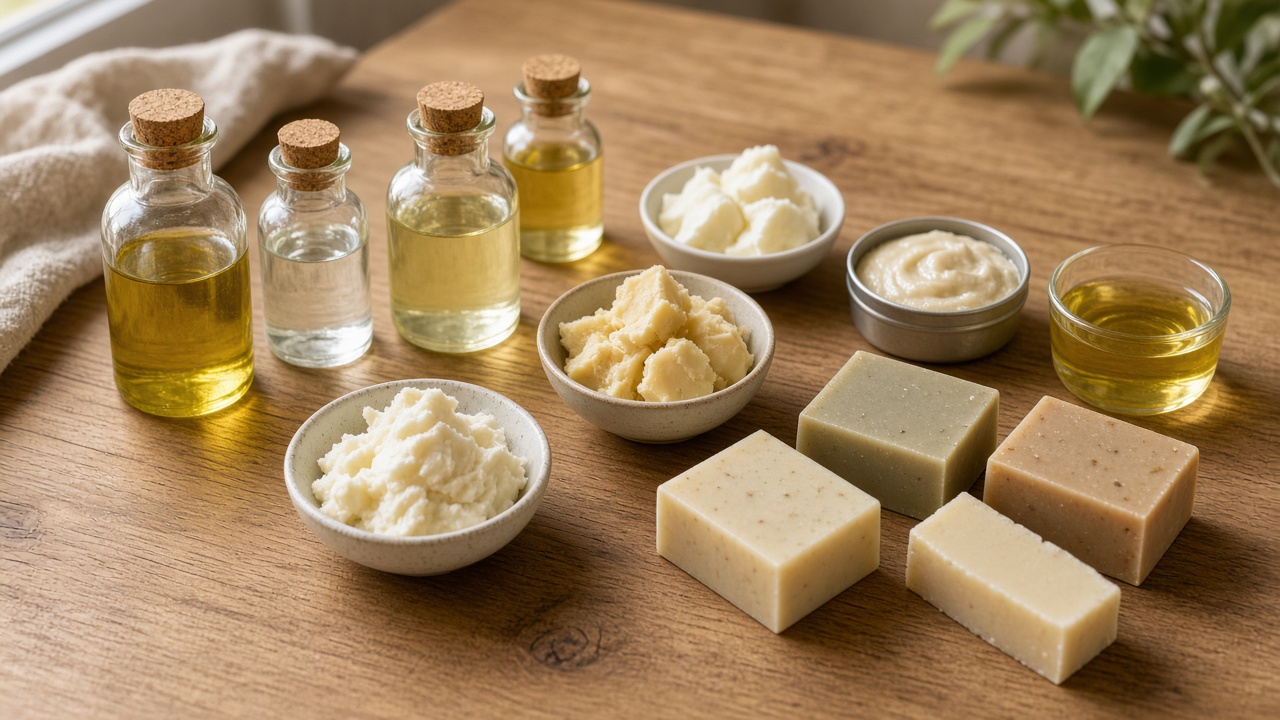
Best Oils for Soap Making: What Each Oil Does in a Soap Recipe
Choosing the right oils is one of the most important parts of creating a good soap recipe.
Two recipes can use the same amount of oil, the same superfat, and the same soap-making process yet produce completely different bars simply because the oils are different.
One recipe may create a hard bar with abundant bubbles.
Another may produce a gentle, creamy soap that takes considerably longer to cure.
Another might be soft, dissolve quickly, or have difficulty producing the type of lather you expected.
The reason is that oils are not interchangeable.
Every oil has its own fatty-acid composition and SAP value, and those differences affect both the amount of lye required and the characteristics of the finished soap.
So when someone asks:
“What are the best oils for soap making?”
the best answer is:
It depends on the soap you want to make.
Most successful formulations use a combination of oils chosen to balance hardness, cleansing, conditioning, lather, longevity, cost, availability, and the soap maker's individual goals.
Why Do Different Oils Make Different Soap?
Soap is produced when fats or oils react with an alkali such as sodium hydroxide or potassium hydroxide.
That reaction is called saponification.
Although we commonly talk about olive oil, coconut oil, tallow, shea butter, and other ingredients as individual oils, each is actually composed of a mixture of different fatty acids attached to glycerol molecules.
Those fatty acids are one of the biggest reasons different oils behave differently in soap.
Common soap-making fatty acids include:
- Lauric acid
- Myristic acid
- Palmitic acid
- Stearic acid
- Ricinoleic acid
- Oleic acid
- Linoleic acid
- Linolenic acid
An oil rich in lauric acid behaves very differently from one dominated by oleic acid.
Likewise, an oil rich in palmitic and stearic acids usually contributes different characteristics than one containing large amounts of linoleic or linolenic acids.
This is why looking only at the name of an oil does not tell you everything about how it will perform.
SoapMetrics allows you to review the fatty-acid profile of a soap recipe as you formulate it, which can make the relationship between individual oils and the overall recipe much easier to understand.
Fatty Acids and Soap-Making Properties
Soap calculators often translate fatty-acid information into characteristics such as hardness, cleansing, conditioning, bubbly lather, and creamy lather.
These measurements are useful formulation tools, but they should not be interpreted as absolute predictions of exactly how a finished bar will feel.
A simplified way to understand some common fatty acids is:
Lauric and Myristic Acids
Often associated with:
- Strong cleansing ability
- Large, quick bubbles
- Hardness
- High solubility
Coconut oil, palm kernel oil, and babassu oil are well-known sources.
High levels can create powerful cleansing soap, which is why these oils are commonly balanced with other ingredients.
Palmitic and Stearic Acids
Often associated with:
- Harder bars
- Longer-lasting soap
- Dense, creamy lather
- Lather stability
Tallow, palm oil, lard, cocoa butter, and shea butter can contribute significant amounts.
Oleic Acid
Often associated with:
- Conditioning characteristics
- Mild-feeling soap
- Creamier rather than highly bubbly lather
- Softer soap initially when present at very high levels
Olive oil and many high-oleic oils are rich in oleic acid.
Ricinoleic Acid
Castor oil is unusual because it contains a large amount of ricinoleic acid.
In soap formulations, castor oil is widely used to support and stabilize lather.
Linoleic and Linolenic Acids
These polyunsaturated fatty acids can contribute conditioning characteristics.
However, formulations containing very large amounts of highly polyunsaturated oils may require more attention to oxidation and shelf stability.
The goal is not necessarily to maximize one fatty acid.
It is usually to create an appropriate balance for the kind of soap you want.
What Are SAP Values?
SAP stands for saponification value.
A SAP value tells a soap calculator how much alkali is required to saponify a given amount of an oil or fat.
Each oil has a different value.
That means 500 grams of coconut oil does not require the same amount of sodium hydroxide as 500 grams of olive oil.
This is critical when substituting oils.
You cannot safely replace one oil with another and simply use the old amount of lye.
The new formula must be recalculated.
If you want a deeper explanation of how this works, see How Much Lye Do I Need for Soap?.
Olive Oil
Olive oil is one of the most recognizable oils in soap making.
Its fatty-acid profile is typically dominated by oleic acid, although the exact composition varies.
In soap, olive oil is generally associated with:
- Conditioning characteristics
- Mild-feeling bars
- Creamy lather
- Relatively low initial bubbly lather
- A slower-moving recipe
- Longer curing benefits when used at very high percentages
Olive oil can be used as part of a blended formulation or as the primary oil in traditional Castile-style soap.
Soap containing very high amounts of olive oil may remain relatively soft early in cure and can continue improving for months.
That makes olive oil an excellent example of why you cannot judge a soap recipe only by how it looks during the first few days.
Our guide to how long soap needs to cure explains why high-olive-oil soaps can benefit from additional aging.
Olive Oil vs. Olive Pomace Oil
Olive oil is available in different grades and extraction methods, including pomace oil.
Both can be used for soap making, but they should be selected correctly in your calculator because ingredient specifications and behavior can differ.
Always use the ingredient that corresponds to the actual material in your recipe.
Coconut Oil
Coconut oil is one of the most useful — and powerful — oils in soap formulation.
It is particularly rich in lauric and myristic acids.
Coconut oil commonly contributes:
- Hardness
- Strong cleansing characteristics
- Abundant bubbly lather
- Quick lather formation
- Good solubility
It is one of the reasons a soap can produce large bubbles even in challenging conditions.
But more coconut oil is not automatically better.
A high-coconut formulation can be extremely cleansing, which may feel drying to some users unless the overall recipe is designed accordingly.
For this reason, coconut oil is often paired with oils that contribute more oleic, palmitic, stearic, or other fatty acids.
The percentage that works best depends on the purpose of the soap and the rest of the formulation.
Castor Oil
Castor oil is quite different from most common soap-making oils because of its unusually high ricinoleic acid content.
It is frequently used as a supporting oil rather than the primary oil in a recipe.
Castor oil can contribute:
- Lather support
- Lather stability
- Creaminess
- Conditioning characteristics
It is often included when a soap maker wants to improve the persistence and quality of the lather generated by the other oils.
Castor oil demonstrates an important formulation concept:
An oil does not have to make up a large percentage of a recipe to have a meaningful effect.
Palm Oil
Palm oil is rich in fatty acids including palmitic and oleic acid and is commonly used to provide structural balance in bar soap.
It can contribute:
- Hardness
- Bar longevity
- Stable lather
- Creamy lather
From a formulation perspective, palm oil can perform a role similar to other hard fats.
However, sourcing and environmental concerns surrounding palm production are important considerations for many soap makers and customers.
Some makers choose certified or responsibly sourced palm oil.
Others avoid it entirely and formulate palm-free recipes using combinations of other fats and butters.
Neither approach eliminates the need to balance the fatty-acid profile appropriately.
Tallow
Tallow is rendered animal fat, commonly sourced from beef.
It has a long history in soap making.
Its fatty-acid composition typically provides significant levels of palmitic, stearic, and oleic acids.
Tallow can contribute:
- Excellent bar hardness
- Long-lasting soap
- Dense, creamy lather
- Stable lather
- Good overall structural balance
Tallow-based formulations can produce very durable bars without requiring extremely high percentages of brittle hard butters.
For soap makers comfortable using animal-derived ingredients, it can be an efficient and useful formulation fat.
Lard
Lard is rendered pork fat and is another traditional soap-making ingredient.
Like tallow, it can provide a combination of saturated and monounsaturated fatty acids that works well in bar soap.
Lard commonly contributes:
- Hardness
- Longevity
- Creamy lather
- Mild-feeling soap
- Good formulation balance
A lard-based bar can feel quite different from one relying heavily on coconut oil for hardness.
This highlights why the generic term “hard oil” does not mean every solid fat produces the same type of soap.
Shea Butter
Shea butter is popular in handcrafted soap and contains substantial amounts of stearic and oleic acids.
It can contribute:
- Hardness
- Creamy lather
- Conditioning characteristics
- A richer-feeling formulation
Shea butter is generally used as part of a blend rather than as the entire oil phase.
It is also more expensive than many basic soap-making oils, so formulation goals and cost should both be considered.
One important point is that adding an expensive butter does not guarantee that the finished bar will automatically be superior.
After saponification, the performance of the soap depends on the complete fatty-acid composition and finished formulation.
Cocoa Butter
Cocoa butter is a particularly hard butter with significant stearic and palmitic content.
In soap it can contribute:
- Hardness
- Bar longevity
- Dense lather
- Structural firmness
Because cocoa butter is very hard, excessive amounts can contribute to a bar that feels brittle or otherwise unbalanced depending on the rest of the formula.
As with most ingredients, its value comes from how it complements the other oils.
Avocado Oil
Avocado oil is a popular liquid oil in handmade soap.
Its composition generally includes significant oleic acid along with smaller amounts of other fatty acids.
It can contribute:
- Conditioning characteristics
- Creamy lather
- A softer oil component within a balanced recipe
Avocado oil is often used alongside harder fats rather than being relied on to create bar hardness by itself.
Its cost can also be higher than basic formulation oils such as olive or canola, making it worth considering whether a particular recipe actually benefits from the added expense.
Sunflower Oil
Sunflower oil deserves special attention because not all sunflower oil is the same.
Standard sunflower oil and high-oleic sunflower oil can have substantially different fatty-acid profiles.
Standard sunflower oil commonly contains much more linoleic acid.
High-oleic sunflower oil has been developed to contain substantially more oleic acid and generally offers greater oxidative stability.
For soap makers, this means:
“Sunflower oil” and “high-oleic sunflower oil” should not automatically be treated as identical ingredients.
Make sure the oil selected in your calculator matches the product you actually purchased.
Canola Oil
Canola is another widely available liquid oil used in soap making.
Its profile is typically dominated by oleic acid with varying amounts of linoleic and linolenic acids depending on the variety.
It can contribute:
- Conditioning characteristics
- A softer component in the formula
- Cost-effective liquid oil content
High-oleic canola varieties also exist, so once again, knowing what type of oil you actually have matters.
Rice Bran Oil
Rice bran oil is frequently used as an alternative or complement to olive oil.
It generally contains a mixture of oleic and linoleic acids along with saturated fatty acids.
In a balanced soap recipe it can contribute:
- Conditioning
- Creamier lather
- A versatile liquid-oil component
Its fatty-acid balance differs from olive oil, so the two should not simply be assumed to be interchangeable without recalculating the recipe.
Sweet Almond Oil
Sweet almond oil is another conditioning liquid oil frequently used in artisan soap formulations.
Its fatty-acid profile commonly contains substantial oleic and linoleic acids.
It can contribute:
- Conditioning characteristics
- Mild-feeling soap
- A softer component of the overall oil blend
Because it tends to cost more than basic commodity oils, it is worth considering whether the amount used meaningfully contributes to your formulation goals.
Which Oils Make Soap Harder?
Soap hardness is influenced substantially by the fatty acids in the recipe.
Oils and fats containing larger amounts of palmitic and stearic acids commonly contribute to harder, longer-lasting bars.
Examples include:
- Tallow
- Lard
- Palm oil
- Shea butter
- Cocoa butter
Coconut oil also creates a hard bar, although its fatty-acid profile and resulting soap behavior are very different.
Hardness should not be pursued independently of everything else.
A very hard bar can still have poor lather, be overly cleansing, feel brittle, or otherwise fail to meet your goals.
Which Oils Make Soap Lather More?
Different oils create different types of lather.
For large, bubbly lather, soap makers commonly rely on oils containing lauric and myristic acids, such as:
- Coconut oil
- Babassu oil
- Palm kernel oil
Castor oil can help support and stabilize lather because of its ricinoleic acid content.
Fats rich in palmitic and stearic acids can contribute more to dense, creamy, stable lather.
This means “more lather” itself has multiple meanings.
Do you want:
- Large bubbles?
- Creamy foam?
- Long-lasting lather?
- Dense shaving-style lather?
Those goals may require different fatty-acid balances.
Which Oils Are Best for Conditioning Soap?
The term conditioning is commonly used in soap calculators to describe fatty-acid characteristics associated with a milder-feeling formulation.
Oils rich in oleic, linoleic, linolenic, and ricinoleic acids often contribute to this metric.
Examples can include:
- Olive oil
- Avocado oil
- Sweet almond oil
- Rice bran oil
- Sunflower oil
- High-oleic sunflower oil
- Canola oil
- Castor oil
However, a high conditioning number by itself does not guarantee a perfect soap.
A formula still needs to be considered as a whole.
Hard Oils vs. Soft Oils
Soap makers often divide ingredients into hard oils and soft oils.
Hard oils and fats are usually solid or semi-solid around room temperature.
Examples include:
- Coconut oil
- Palm oil
- Tallow
- Lard
- Cocoa butter
- Shea butter
Soft oils are generally liquid at room temperature.
Examples include:
- Olive oil
- Avocado oil
- Sunflower oil
- Rice bran oil
- Sweet almond oil
- Canola oil
This distinction is useful, but it is an oversimplification.
Two hard oils can have very different fatty-acid profiles.
Likewise, two liquid oils can behave very differently in soap.
Use the hard-versus-soft classification as a starting point — not as the complete formulation strategy.
High-Oleic Oils in Soap Making
You may see the words “high oleic” increasingly often when shopping for soap-making oils.
High-oleic varieties have been selected or bred to contain a larger percentage of oleic acid than their conventional counterparts.
Common examples include:
- High-oleic sunflower oil
- High-oleic safflower oil
- High-oleic canola oil
These oils can differ considerably from the standard versions, particularly in the balance between oleic and polyunsaturated fatty acids.
That can affect:
- Soap characteristics
- Oxidative stability
- Shelf life
- Fatty-acid analysis
Always choose the correct oil variant when entering a recipe.
Do Expensive Oils Make Better Soap?
Not necessarily.
This is an important concept for both hobbyists and soap businesses.
An expensive exotic oil may be wonderful, but the cost of an ingredient does not automatically correspond to how much it improves a finished wash-off soap product.
Remember what happens during soap making:
The oils are chemically transformed through saponification.
The characteristics of the finished soap depend heavily on the fatty acids that remain as soap salts and on the overall formulation.
A $30-per-pound specialty oil may not automatically produce a better bar than a carefully balanced combination of affordable oils.
This does not mean specialty oils have no place.
They can be chosen for:
- Formulation characteristics
- Marketing
- Ingredient stories
- Product positioning
- Availability
- Customer preferences
- Specific fatty-acid contributions
But use them intentionally.
How Many Oils Should Be in a Soap Recipe?
There is no required number.
A successful recipe might contain:
- One oil
- Three oils
- Five oils
- Eight oils
Adding more oils does not automatically make a recipe more sophisticated or better.
A simple formulation might achieve everything you need with:
- A bubbly/cleansing oil
- A hard/long-lasting fat
- A conditioning liquid oil
- A lather-supporting oil
Other recipes may need additional ingredients to achieve a particular goal.
The objective should be purposeful formulation, not maximizing the ingredient count.
How to Choose Oils for Your Soap Recipe
Rather than asking which oil is universally best, start by asking what you want the finished soap to do.
Do You Want More Bubbles?
Consider the lauric and myristic contribution.
Do You Want a Harder, Longer-Lasting Bar?
Look at palmitic and stearic acids.
Do You Want More Creamy Lather?
Consider the balance of palmitic, stearic, oleic, and ricinoleic characteristics.
Do You Want a Mild, Conditioning Formula?
Examine the overall cleansing and conditioning balance rather than simply adding one “gentle” oil.
Do You Need a Longer Working Time?
High-oleic recipes often behave differently during trace than formulations containing large amounts of hard fats.
Our article Why Is My Soap Not Tracing? Understanding False Trace in Soap Making explains how the oil blend and temperature can influence trace behavior.
How Long Are You Willing to Cure the Soap?
A formulation heavily based on high-oleic liquid oils may benefit from considerably more cure time than a recipe designed around harder fats.
What Does the Recipe Cost?
For commercial soap makers, formulation also needs to make economic sense.
An excellent bar that costs more to manufacture than customers are willing to pay may not be a sustainable business formula.
SoapMetrics provides tools to help you formulate and analyze a soap recipe while comparing the effects of your oil choices.
Always Recalculate When Changing Oils
One of the most important rules in soap formulation is:
Never substitute an oil without recalculating the lye requirement.
Every oil has its own SAP value.
Suppose your recipe calls for olive oil and you decide to replace some of it with coconut oil.
Even if the total oil weight remains identical, the required amount of sodium hydroxide changes.
The same applies when substituting:
- Tallow for palm
- Lard for tallow
- Babassu for coconut
- Sunflower for olive
- Shea butter for cocoa butter
- Any other fat or oil
Do not assume two oils that perform similarly require the same amount of lye.
Enter the revised formulation into a soap and lye calculator and recalculate it before making the batch.
What About Superfat?
Superfat is another important piece of the formulation.
The oils determine the theoretical lye requirement, while your selected superfat adjusts how much lye is ultimately used.
Changing oils can alter the recipe even if you leave the superfat percentage unchanged.
If you are unsure how the setting works, read What Is Superfat in Soap Making?.
Superfat should be considered alongside the oil blend — not as a substitute for creating a balanced formula.
The Best Oil Is Usually a Balanced Combination
So, what are the best oils for soap making?
There is no single winner.
Coconut oil can provide tremendous bubbles and cleansing.
Olive oil can contribute a high-oleic, conditioning foundation.
Castor oil can support lather.
Tallow, lard, or palm oil can provide hardness and longevity.
Shea and cocoa butter can add hard, stearic-rich components.
Avocado, rice bran, sunflower, almond, and other liquid oils can contribute their own fatty-acid characteristics.
The best combination is the one that produces the type of soap you actually intend to make.
Instead of looking for a magic oil, learn what each ingredient contributes and evaluate the entire fatty-acid profile.
That is where soap formulation becomes much more powerful.
SoapMetrics lets you build a recipe with the SoapMetrics soap calculator, compare oils, review fatty-acid information, evaluate soap properties, adjust your formulation, and see how the recipe changes before you commit ingredients to a batch.
And whenever you change an oil, percentage, lye type, or other major formulation setting, take a moment to recalculate the entire recipe. Even familiar oils have different SAP requirements, and sodium hydroxide and potassium hydroxide are caustic materials that deserve accurate measurements and careful handling every time you make soap.